Add-On & Stand-Alone Solution
4C Carbon Footprint Certification
4C Carbon Footprint
4C Carbon Footprint Certification
Reducing coffee’s carbon footprint
The agriculture sector is responsible for approximately 25% of global greenhouse gas emissions and the coffee industry plays its part. As pressure grows to reach net zero targets, coffee companies must act by empowering producers, building sustainable supply chains and cutting emissions.
However, measuring the carbon footprint of coffee remains complex and inconsistent. Current tools and methodologies often lack standardisation, making it difficult for businesses to take clear action.
To address this, 4C has developed a dedicated carbon footprint solution for the coffee sector, built on a robust, transparent methodology and certified by an independent third party. This solution brings consistency, credibility and actionable insights to help your coffee business progress towards a more sustainable future.
4C has developed a dedicated carbon footprint solution for the coffee and cocoa sector
Credible climate action for coffee
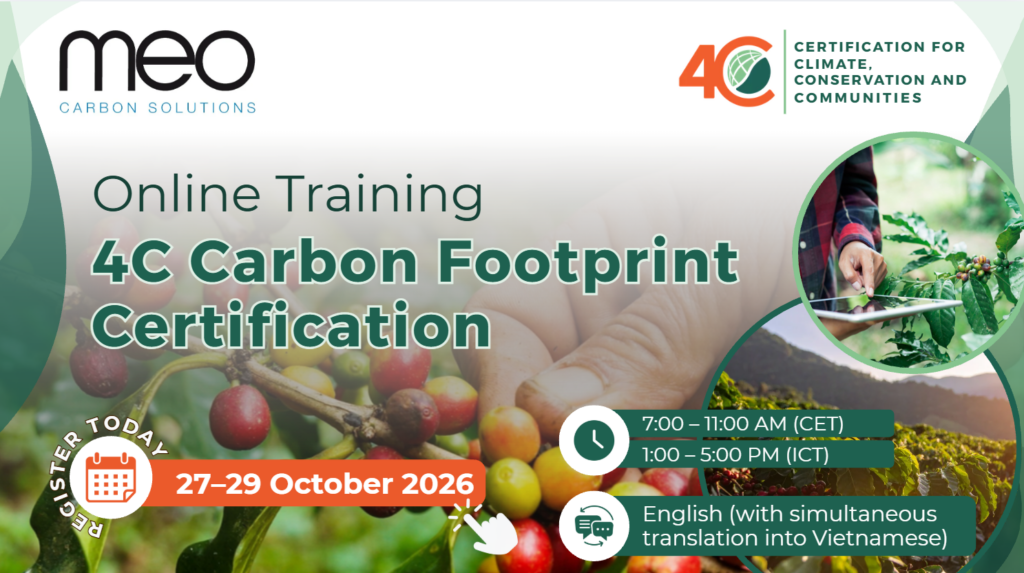
Don’t miss our upcoming 4C Carbon Footprint Certification Online Training
Whether you represent a producer group, exporter, trader, roaster or certification body, this interactive course equips your team with the practical methodology needed to evaluate emissions, address hotspots and substantiate your sustainability claims.
What you will gain:
- Practical mastery of GHG calculation methodologies across farm, post-harvest processing, transport, and distribution.
- Clear frameworks for developing actionable Improvement Plans to drive continuous emissions reduction.
- Expertise in navigating 4C certification rules, audit procedures, and B2B/B2C sustainability claims.
- Hands-on experience through interactive group exercises and direct Q&A with technical experts.
CLICK HERE to view the detailed 3-day agenda and confirm your spot

Steps to Conduct GHG Calculation

Four Levels of Implementation
From GHG emissions calculation to climate friendly coffee
4C calculates greenhouse gas (GHG) emissions across the entire coffee supply chain, supports mitigation planning and monitors emission reductions. A dedicated Improvement Plan tracks the performance of 4C Units and farmers in reducing emissions. Verified carbon footprint results are used for the 4C Carbon Footprint Add-On certification.
Rooted in Credibility. Grounded in Science.
What sets 4C apart in carbon certification


Where 4C Carbon Footprint Certification is Making an Impact

Applying for the 4C Carbon Footprint Add-On
When applying for the 4C Carbon Footprint Add-On, 4C system users shall comply with the core 4C procedures and requirements for certification
The baseline GHG calculation should be made available before applying for the Add-On certification
Main conditions
- Prerequisites for 4C core certification fulfilled.
- GHG emissions calculated following standards and methodologies approved by 4C.
More information
All operations and facilities responsible for coffee production and post-harvest processing covered by a 4C certificate are eligible to apply for the Add-On. The Add-On can be implemented globally, regardless of the type of coffee produced or the cultivation practices employed.
Only Certification Bodies (CBs) cooperating with 4C are approved to conduct the Carbon Footprint Add-On audits. Once all requirements for 4C Climate Friendly (or Neutral) Coffee are successfully fulfilled, the existing 4C core certificate receives an amendment confirming the successful application of the Add-On. 4C system users have the right to use of the respective logos and claims, according to 4C logo use policy, to communicate their efforts to reduce greenhouse gas (GHG).
Join us in the journey to a more carbon friendly future!
Together, we can reduce greenhouse gas (GHG) emissions in coffee production and supply chains and combat climate change.
Join us in the journey to a more carbon friendly future!
Together, we can reduce greenhouse gas (GHG) emissions in coffee production and supply chains and combat climate change.

Further Information
Further Information