Food Security
Why Food Security Matters
Food Security in Agricultural Supply Chains
Food security is one of the most fundamental human rights challenges facing agricultural supply chains today. While coffee and cocoa are globally traded commodities, many farming households and workers involved in their production still face risks related to hunger, malnutrition, limited access to nutritious food or seasonal food shortages.
As sustainability expectations grow, companies are increasingly expected to understand not only environmental and labour-related risks, but also whether their sourcing practices support or undermine people’s ability to access adequate food.
The 4C Food Security Add-On was developed to help businesses identify, assess and address food security risks while demonstrating respect for the internationally recognised Human Right to Food.
What Is Food Security?
According to the FAO, food security exists when people have physical and economic access at all times to sufficient, safe, and nutritious food for a healthy and active life.
For businesses, this means looking beyond income alone and understanding whether workers, farmers and communities can reliably obtain and consume nutritious food throughout the year.
The Four Pillars of Food Security
Food Availability
Food is available in sufficient quantity and quality to meet dietary needs.
Food Access
People can obtain nutritious food through income, food production, functioning markets and infrastructure.
Food Utilisation
People have access to safe food, clean water, healthcare, sanitation and adequate nutrition knowledge.
Food Stability
People can maintain access to food over time, including during seasonal gaps, economic shocks, health crises or climate-related disruptions.
Food Security Standard (FSS)
What Makes the Food Security Standard Unique?
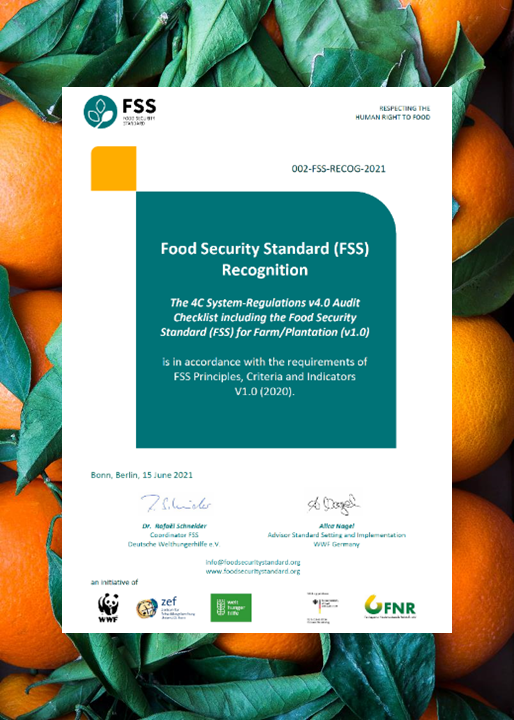
The Food Security Standard (FSS) is designed specifically to operationalise the Human Right to Food through measurable indicators and independent verification.
Key differentiators include:
- Holistic approach to food security
- Human-rights-based methodology
- Alignment with FAO guidance
- Independent third-party auditing
- Compatibility with existing sustainability standards
- Focus on agricultural supply chains
The methodology was developed by organisations including Deutsche Welthungerhilfe, WWF and the Centre for Development Research (ZEF), with support from Meo Carbon Solutions.

“Food security requires a joint action of everyone involved in the coffee sector. Coffee-importing companies can trigger and support this action, if they request integrating the FSS into sustainability audits and support its implementation. This way, companies show sensitivity for local challenges and promote a deeper understanding of the food security situation in the region. Gaps and areas for improvement can be identified and a continuous improvement initiated via certification”
Dr. Rafaël Schneider
Coordinator of the FSS Project and Deputy Director Policy Department at Deutsche Welthungerhilfe e. V., Bonn, Germany and 4C Board Member
Conditions and Process
Applying for the 4C Food Security Add-On
Main Conditions
- A valid 4C certificate or the willingness to obtain one to guarantee compliance with 4C core sustainability criteria.
- Desire to strengthen food security through a credible third-party certification.
Process
The 4C Food Security Add-On presents a deeper integration of the food security topic into the 4C certification system. Once a Managing Entity of a 4C Unit* submits an application to participate in this voluntary extension of the 4C certification, it will become a part of the 4C Unit’s regular established certification and audit procedures, including onsite audits, annual updates, and improvement plans.
To download and get familiar with the 4C Food Security audit checklist, please refer to the document library.
*In 4C terminology, 4C Units are 4C certified coffee-producing groups managed by Managing Entities. For complete definitions, please consult our glossary here.

Build More Resilient Coffee and Cocoa Supply Chains
Food security is a foundation for sustainable agriculture, thriving communities, and responsible sourcing. The 4C Food Security Add-On helps companies move beyond assumptions and gain credible, verifiable insights into one of the most important human rights issues in agricultural supply chains.
Contact our team to learn how the Food Security Add-On can support your sustainability and due diligence objectives

Further Information